
Introduction
Blast furnaces play an important role in steel production, reducing iron ore into iron through a high-temperature reduction smelting process. In this article, we will take a closer look at how a blast furnace works, its parts and functionality, and its use in other areas.
What is a Blast Furnace?
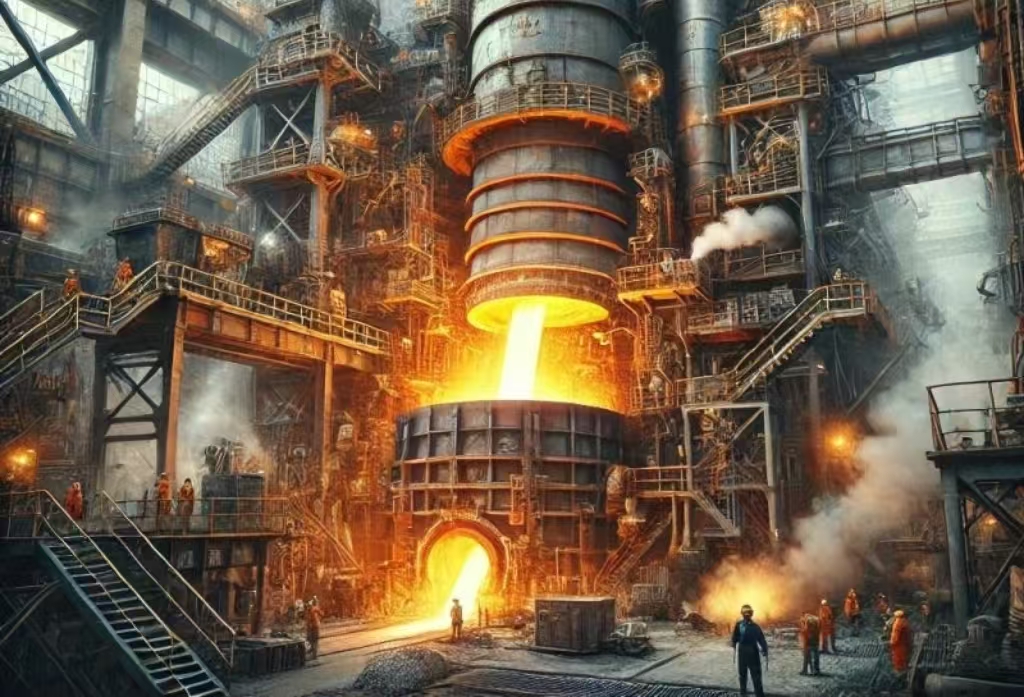
Fundamentally, blast furnaces are tall, vertical shafts that use heat and chemical reactions to transform iron ore into molten iron. Essentially, it’s a huge steel box that works under high pressure and heat, converting iron ore into the metal that is the main input in steelmaking. The word “blast” actually refers to the high-pressure air that’s driven into the furnace to sustain the process. The Basic Oxygen Furnace (BOF) is mainly employed in the manufacture of iron and steel, and its usage has evolved over the centuries.
Main Ingredients in a Blast Furnace
Iron Ore
Iron ore is the primary iron feed in the blast furnace, which is usually oxides such as hematite (Fe2O3) or magnetite (Fe3O4). These ores have a high iron content, but the metal is chemically combined with oxygen and other elements. Iron ore is converted to iron by chemical reactions.
Coke
Coke is a carbon-intensive material produced through heating coal in the absence of oxygen.
Limestone
To help remove impurities in the iron ore such as silica in the furnace, limestone is used. these impurities are mixed when it is limestone is formed into a by product are called up slag from the furnace.
The formulation in blast furnace for iron production means these materials are charged into the furnace under defined conditions.
How the Blast Furnace Works?
The blast furnace is charged with iron ore, coke and limestone and goes. The shard and fibrous materials are introduced at the top of the furnace in alternatively layered fashion. Now the furnace works on a very high temperature of about 2000°C (3632°F) Hot air is blown into the furnace from the bottom, igniting the coke and setting up the chemical reactions that will decompose the ore.
The materials go through several processes from the top to the bottom of the furnace, which will produce liquefied iron at the bottom of the furnace. It helps to consider each stage in detail: the heating, the chemical reactions, and the separation of the impurities — one can see how the blast furnace works.
The Role of Air in the Furnace
A tuyere or special nozzle at the bottom of the furnace injects air into the furnace. The blown air contributes a fresh supply of oxygen to keep the coke burning, with carbon dioxide and carbon monoxide as the products of the reaction. This CO is crucial, as it is a reducing agent that reacts with the iron ore to obtain iron.
The super high pressure air is necessary to maintain the proper temperature in the blast furnace which facilitates the chemical reaction. Without this blast of air, chemical reactions will not take place efficiently, and the furnace will be unable to produce molten iron.
Blast Furnace Reactions
Reduction of Iron Ore
The coke generates carbon monoxide (CO) and it reacts with iron(III) oxide (Fe2O3) according to:
Fe2O3+3CO→ 2Fe+3CO2
This reaction kicks oxygen out of the iron ore, producing pure iron (Fe) which becomes liquid iron that settles on the bottom of the furnace.
Formation of Slag
Limestone (CaCO3) is introduced to combine with impurities in the iron ore, such as silica (SiO2), forming slag:
CaCO3→ CaO+3CO2
The calcium oxide (CaO) then combines with impurities to form calcium silicate (slag), which rises to the top of the molten iron.
These reactions are the cornerstone of blast furnace reactions that convert raw materials into usable molten iron.
The Molten Iron and Slag
Once the reaction is over, the molten iron sinks to the bottom of the furnace and the slag floats to the top. Iron oxide, as the raw material is known, falls to the bottom of the furnace, where it melts, and the molten iron is drawn off through a special valve. Impure material, known as “slag,” is taken out of the furnace separately.
Tapping the Molten Iron
Once enough molten iron has formed at the bottom of the furnace, it is “knocked” out through a spout and into a mold or container. This iron, called pig iron, is the raw material for additional steel production. It’s in this steelmaking furnace, where it’s going to be reduced in carbon and used to make steel. Iron produced in blast furnaces plays a key role.
What Happens to the Slag?
The waste products from the blast furnace are not wasted. It is frequently recycled for construction work, appears in pavement, or is processed even further for cement. The slag can, in some cases, also be treated so that the iron content can be recovered, and is hence a valuable byproduct.
Temperature and Control
Optimizing the blast furnace operation requires careful controls on the temperature. If it’s too cold, the reactions won’t be efficient. If too high, the furnace can be damaged. Temperature Control Coke or air flow amount adjustments. These factors were later embedded into advanced blast furnace control systems to adjust accordingly and control blast furnace smooth operation.
The Role of the Blast Furnace in Steel Production
The blast furnace is a large melting furnace that is a key part of the steel production process. Its main function is to convert iron ore into hot metal for steelmaking.
The process is that iron ore and coke are fed from the top of the blast furnace, and reducing gases at the bottom move upward. Finally, the iron oxide is converted into hot metal.
So, the blast furnace produces pig iron, which is then converted into steel in the second step.
Modern Improvements
Newer technologies have developed to make blast furnaces more of an energy efficient and ecologically sound option. Newer furnaces have sophisticated control mechanisms to optimize temperature, air flow and input of materials. Not only can blast furnaces run on alternative materials — for example, biomass — to cut carbon emissions. But they are also increasingly being designed to at least run on alternative materials to reduce carbon emissions as they do. So helping the industry transition to sustainable practices.
Conclusion
The blast furnace is an essential component of steel-making and other industries. That is why understanding the blast-furnace process, and what takes place in it, enables you to appreciate how complex industrial manufacturing can be. The tenets of blast furnace operation have driven industries for centuries and continue to bear a vital role in modern day manufacturing.
 EN
EN  RU
RU  TR
TR  FR
FR  DE
DE  KO
KO  UK
UK  JA
JA  PT
PT  CEB
CEB  AZ
AZ  BN
BN  VI
VI  ES
ES  ES_ES
ES_ES  ID
ID  IT
IT  ES_AR
ES_AR  HI
HI  AR
AR  KK
KK  EL
EL  ZH
ZH  FA
FA  NL
NL