Advantages of graphite marble mold
Wide temperature stability
It can maintain structural stability within a temperature range of -200°C to 800°C without cracking or deformation.
Ultra-high surface precision
Because the dense texture and smooth surface of marble, it allows the mold forming surface to achieve micrometer-level precision. This ensures that the finished products have no flaws and do not require secondary polishing.
Anti-sticking and easy demolding
Its low surface tension makes the finished products less likely to stick to the mold after high-temperature molding. This allows for smooth demolding directly, reduces the damage rate of the finished products and improves production efficiency.
Strong chemical inertness
It is not prone to reacting with corrosive media, which makes it suitable for producing materials with corrosive components.
High structural strength
It can withstand pressure impacts during the molding process, which is unlikely to deform over a long period of use.
Good thermal conductivity uniformity
Because of the excellent thermal conductivity, it ensures uniform temperatures in all parts of the mold. And it prevents internal stress or structural defects in the finished products due to local temperature differences.
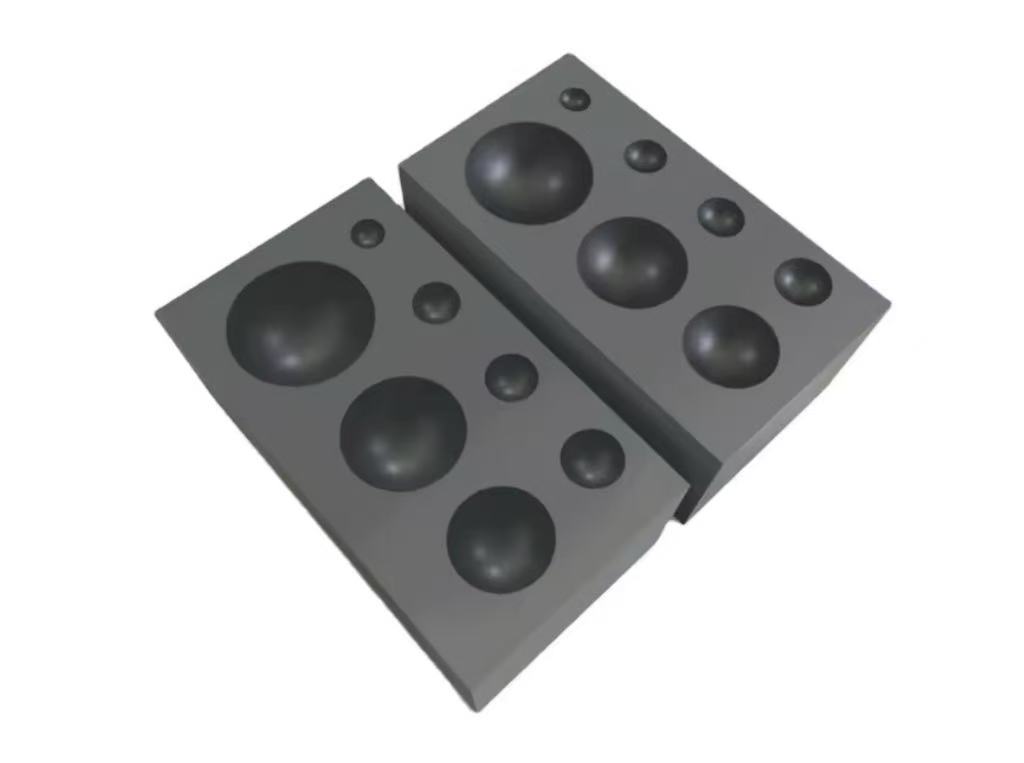
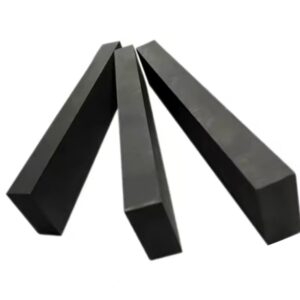
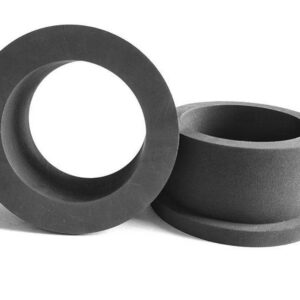
In addition, graphite marble mold is mostly in the form of flat plates or customized irregular structures. And according to your specific production requirements, it will be precisely processed to meet the corresponding specification requirements.
Uses of graphite marble mold
Building Materials and Decoration Field
Production of artificial stone
You can use it for casting artificial marble and quartz stone panels, which ensures the smooth and flat surface of the panels. And it also prevents the high-temperature resin from adhering, thereby improving the qualification rate of the finished products.
Forming of high-temperature resistant decorative parts
You can use graphite mold to produce decorative components for use in high-temperature environments such as fireplace panels, laboratory countertops. With the heat resistance and surface accuracy, it ensures that the decorative parts are both practical and aesthetically pleasing.
Special materials field
Special ceramic molding
Due to the uniform thermal conductivity, you can use it for sintering special ceramic components such as alumina. It can prevent cracking during ceramic sintering, and the structural strength of marble can withstand the pressure.
Composite material component production
You can use it to produce components that require high-temperature curing such as glass fiber reinforced composite materials. With the chemical inertness, it can prevent reactions with the composite material resins, ensuring the performance of the components.
The field of handicrafts and precision components
Casting of high-temperature handicrafts
You can also use it for the production of glass and high-temperature ceramic handicrafts. It can precisely reproduce the complex patterns of the handicrafts, which ensures the smooth demolding of the finished products.
Auxiliary molding for precision electronic components
It can ensure the dimensional accuracy of the components, which is used for the production of some high-temperature-resistant electronic component casings or bases. And its thermal conductivity helps with the cooling and shaping of the components after molding.



 HI
HI  EN
EN  RU
RU  TR
TR  FR
FR  DE
DE  KO
KO  UK
UK  JA
JA  PT
PT  CEB
CEB  AZ
AZ  BN
BN  VI
VI  ES
ES  ES_ES
ES_ES  ID
ID  IT
IT  ES_AR
ES_AR  AR
AR  KK
KK  EL
EL  ZH
ZH  FA
FA  NL
NL