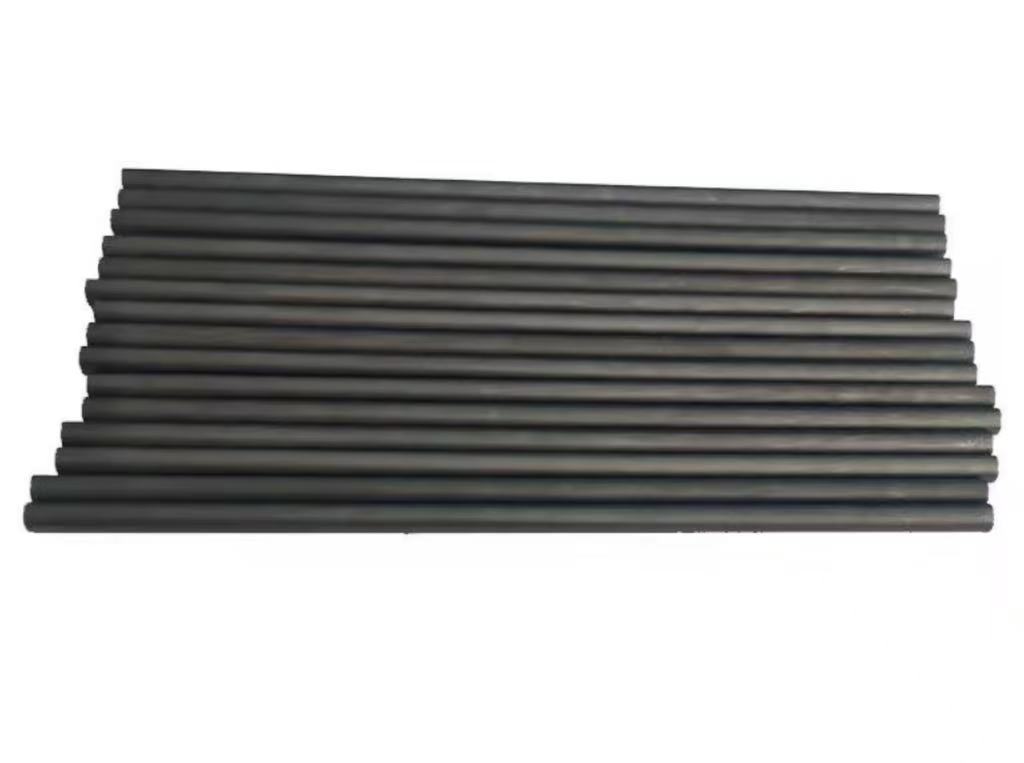
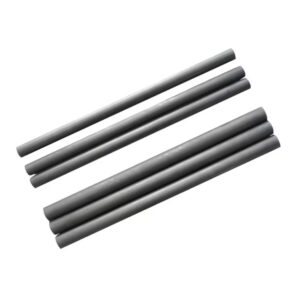
Advantages of fine grain graphite rod
Its advantages lie in its performance stability and application compatibility, specifically including the following several points.
Extremely high heat resistance
Graphite rods can maintain structural stability in environments with temperatures above 2000℃, without softening or deforming. And it is suitable for high-temperature heating and melting scenarios.
Excellent electrical conductivity and thermal conductivity
The electrical current is transmitted evenly and the heat loss is low, which is suitable as a precision electrode component.
Good chemical inertness
It is resistant to strong acids, strong bases and most corrosive gases. So it has a long service life in harsh environments such as in the chemical industry and electrolysis.
Low friction coefficient and high wear resistance
The surface is smooth and the structure is dense, resulting in a low wear rate, which can reduce equipment wear.
High structural density
The fine grain characteristics make it have a higher density and a lower porosity. This prevents impurities from penetrating and improves reliability in precision applications.
Uses of fine grain graphite rod
Precision Manufacturing Field
Electrical discharge machining (EDM) electrode
You can use it to process complex metal molds (such as automotive component molds and electronic component molds). Its fine grain structure ensures uniform current conduction, reduces electrode wear, and improves mold processing accuracy.
Semiconductor industry
You can use fine grain graphite rod as the wafer carrier rod for semiconductor single crystal furnaces because of its high purity characteristics. It can prevent contamination of semiconductor materials and meet the precise requirements of chip manufacturing.
High-Temperature Industrial Field
High-temperature experimental equipment
You can use it as the heating element for high-temperature experimental equipment such as muffle furnaces and vacuum furnaces. It can stably generate heat at temperatures above 3000℃, meeting the experimental needs such as material high-temperature testing.
Metal melting
You can use it as an auxiliary electrode for the melting of non-ferrous metals (aluminum, copper). It conducts current while withstanding high-temperature melting and ensures the stability of the melting process.
Chemical and Electrolysis Field
Electrode of the electrolytic cell
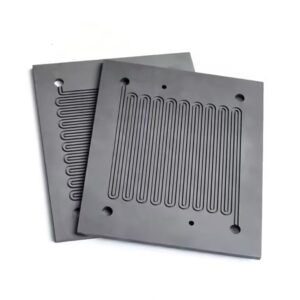
In scenarios such as chlor-alkali industry and metal electrolysis purification, it serves as the electrode of the electrolytic cell. It can resistant to corrosive media such as strong acids and strong alkalis, which is capable of long-term stable operation.
Chemical equipment components
As support rods and flow guiding rods in chemical reactors, it resists the erosion of corrosive gases or liquids in the reactor. And then it can extend the service life of the equipment.
Mechanical and General Field
Precision mechanical components
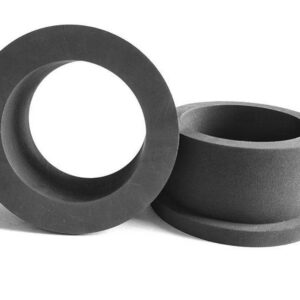
You can use it as high-temperature bearings and sealing sleeve. Its low friction property can reduce the wear of mechanical components and lower equipment maintenance costs.
Protective sleeves for high-temperature temperature sensors
Its high-temperature resistance and thermal conductivity can ensure accurate temperature detection by the sensor in high-temperature scenarios.


 HI
HI  EN
EN  RU
RU  TR
TR  FR
FR  DE
DE  KO
KO  UK
UK  JA
JA  PT
PT  CEB
CEB  AZ
AZ  BN
BN  VI
VI  ES
ES  ES_ES
ES_ES  ID
ID  IT
IT  ES_AR
ES_AR  AR
AR  KK
KK  EL
EL  ZH
ZH  FA
FA  NL
NL