Advantages of graphite furnace tube
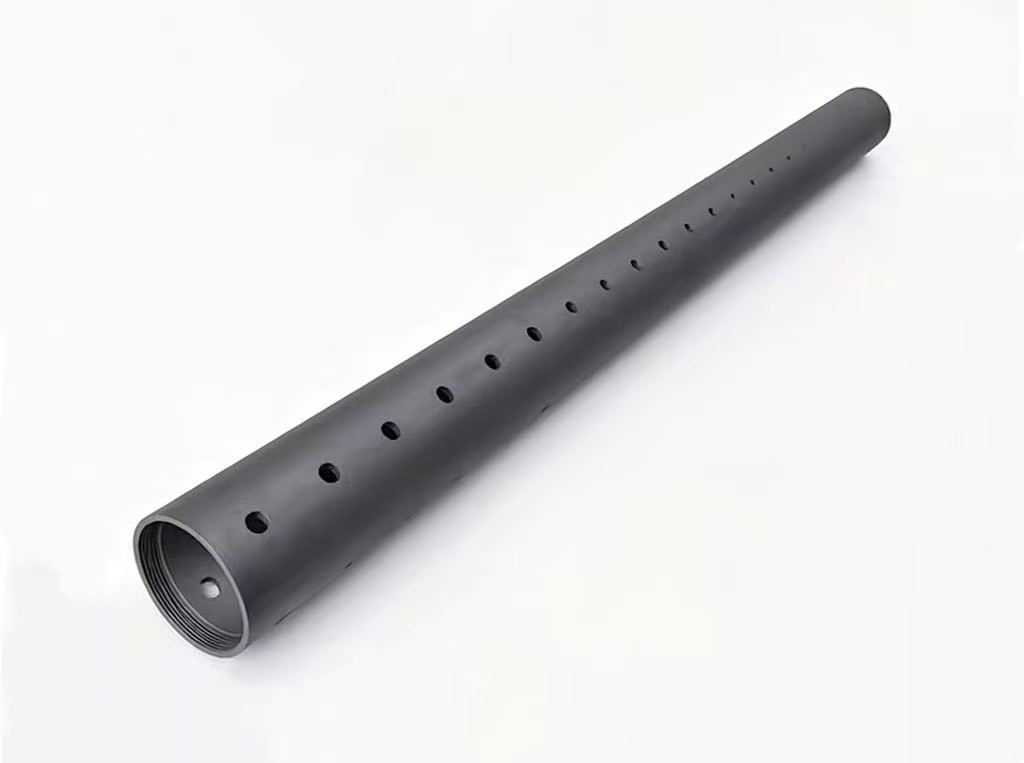
It is mostly in the form of straight cylindrical tubes, flanged tubes, or segmented assembled tubes with significant overall advantages.
Excellent thermal radiation performance
It has a uniform temperature field inside the tube, without problem of excessive local temperature difference.
Excellent thermal shock resistance
It can withstand repeated temperature rise and drop impacts, which is not prone to cracking or deformation.
Regular overall structure
It is easy to process, cut, and customize assembly, so it has outstanding durability.
Excellent overall heat conductivity
It can quickly and uniformly transfer heat, which ensures that the internal workpieces of the furnace tube are heated uniformly.
Excellent electrical conductivity and high-temperature resistance
Because if these, it is suitable for high-temperature electric heating systems.
Extremely strong high-temperature thermal stability and inert chemical properties.
Uses of graphite furnace tube
New Energy Materials Field
Powder Carbonization and Coating
You can use it for the high-temperature carbonization and surface coating processes of new energy powder materials. Because of its clean and impurity-free, high-temperature stable characteristics, it can ensure the complete crystallization. And it can meet of purity standards of powder materials, which improves the conductivity and cycle stability of battery materials.
New Materials Field
Ceramic Powder Sintering
It has internal uniform temperature field, which does not react with the powder. So it enables the production of high-purity, consistent new ceramic raw materials, meeting the production standards of precision ceramic components.
Carbon Fiber Industry
Fiber High-Temperature Heat Treatment
It can withstand ultra-high-temperature continuous operation, so it provides stable conditions for carbon fiber carbonization, shaping, and modification. And then enhancing the strength and modulus performance of carbon fibers.
Industria metalúrgica
Special Alloy Tempering
When using in vacuum tempering and quenching heat treatment processes, it can isolate air and prevent the oxidation and decarburization of the workpiece. And it also optimizes the metal microstructure, which improves the mechanical properties and corrosion resistance of special alloys.
Experimental Research Field
High-Temperature Experimental Sintering
You can use it for the development of various new materials samples, high-temperature synthesis, and thermal analysis experiments. Because of its high equipment fault tolerance and strong experimental stability, it is suitable for small-batch high-temperature tests of multiple types of materials.
Fine Chemical Industry
High-Temperature Material Synthesis
You can also use it for synthesis and modification processing of some high-temperature-resistant fine chemical raw materials and carbon composite materials. It can avoid high-temperature oxidation and deterioration, which ensures the purity and performance of chemical products.


 ES
ES  EN
EN  RU
RU  TR
TR  FR
FR  DE
DE  KO
KO  UK
UK  JA
JA  PT
PT  CEB
CEB  AZ
AZ  BN
BN  VI
VI  ES_ES
ES_ES  ID
ID  IT
IT  ES_AR
ES_AR  HI
HI  AR
AR  KK
KK  EL
EL  ZH
ZH  FA
FA  NL
NL