Advantages of PTFE graphite
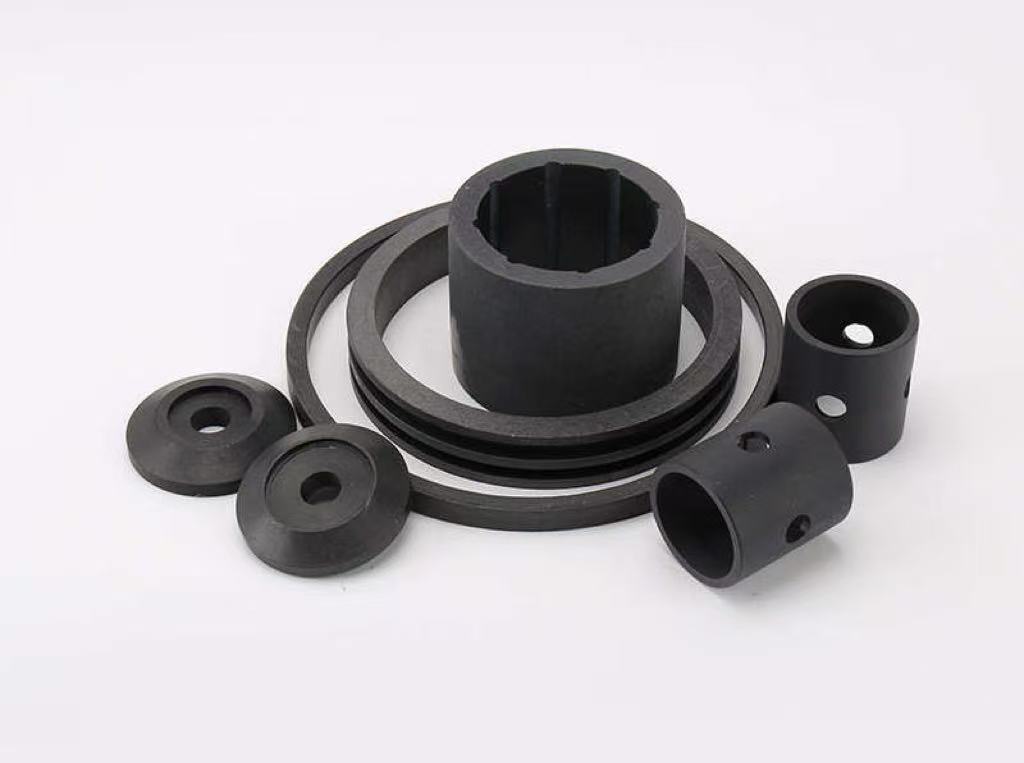
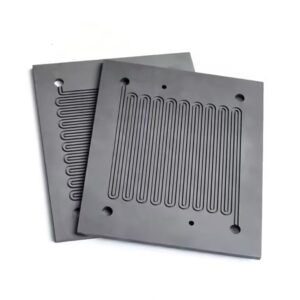
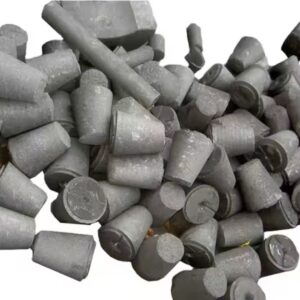
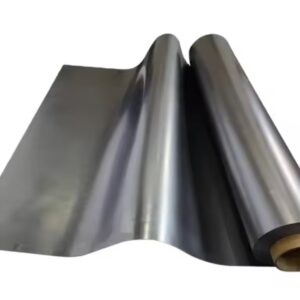
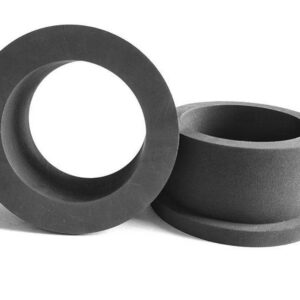
You can process it into various forms such as rods, plates, pipes, gaskets, and special-shaped parts, and it has outstanding comprehensive advantages.
Strong high-temperature thermal stability
It possesses stable performance over a wide temperature range, which has long-term stable use in the -200℃ to 260℃ range.
Extremely strong chemical inertness
It can withstand corrosion from most strong acids, strong bases, and organic solvents.
Extremely low friction coefficient
It has a long-lasting self-lubricating effect without the need for additional lubricant addition.
Harika termal iletkenlik
Because of adding graphite, it significantly improves the shortcomings of pure PTFE, which makes it less prone to heat accumulation and deformation during operation.
Excellent dimensional stability
It is unlikely to deform under long-term pressure, and it is easy to be cut, machined, and molded, and the processing is convenient.
Uses of PTFE graphite
Mechanical transmission industry
Sliding bearings, shaft sleeves, and guide rings
Grafit effectively improves the defect of easy creep deformation of pure PTFE, which significantly enhances the wear resistance and durability. So you can use it for various oil-free lubrication transmission structures such as water pumps, fans, and reducers. It can reduce component wear, eliminate abnormal noises during operation, decreasing the frequency of regular oil changes and component replacements. And it significantly reduces the daily maintenance time and cost of equipment, which is suitable for transmission conditions requiring long-term continuous operation.
Gasket, valve seat, piston ring
Due to its strong chemical inertness, it is able to withstand erosion from oil, water vapor, and various fluid media. And because of its dense material, it can effectively prevent the leakage of oil, gas, and liquid media, ensuring long-lasting sealing without failure. You can use it in conjunction with hydraulic units, industrial pipeline valves, air compressors, etc., which extends the replacement cycle of the sealing parts.
Chemical Industry Corrosion Prevention Field
Chemical pump liners, reactor sealing components, and pipe gaskets
It has extremely strong resistance to chemical corrosion, which will not swell, crack, or corrosion damage. And it combines both anti-corrosion and wear resistance properties, which is suitable for transporting high-temperature chemical materials and for the sealing of reactors. It can prevent direct contact of corrosive media with metal equipment, protecting the pump body, reactor body, and pipes from erosion.
Energy and Power Industry
Oil pump seal, lithium battery equipment anti-static slider
Because it can quickly discharge static electricity, it prevents the accumulation of static electricity and the generation of sparks. Thus avoiding potential risks of flammability and explosiveness, which meets the triple requirements of wear resistance, corrosion resistance, and anti-static properties.
General industrial equipment
Automated equipment slide rails, wear-resistant pads, and friction components for packaging machinery
With high stable and low temperature performance, it operates without lubrication throughout the process. So you can use it for automated production lines and high-speed reciprocating sliding conditions of packaging equipment. It significantly reduces the frequency of equipment shutdown for maintenance and replacement of friction components.

 TR
TR  EN
EN  RU
RU  FR
FR  DE
DE  KO
KO  UK
UK  JA
JA  PT
PT  CEB
CEB  AZ
AZ  BN
BN  VI
VI  ES
ES  ES_ES
ES_ES  ID
ID  IT
IT  ES_AR
ES_AR  HI
HI  AR
AR  KK
KK  EL
EL  ZH
ZH  FA
FA  NL
NL