
Carbon is one of the most widely distributed elements in nature, which has formed a rich variety of allotropes. It has unique bonding characteristics such as high temperature resistance, corrosion resistance, electrical and thermal conductivity, and self-lubrication. Among them, carbon materials and graphite products have become indispensable key basic materials in modern industry. You can use it in traditional metallurgy, chemical fields and high-end manufacturing fields such as new energy, semiconductors, aerospace. Carbon and graphite products play an irreplaceable role and its product manufacturing directly drive technological innovation and high-quality development.
Overview of Carbon and Graphite Materials
Structure and Properties of Carbon Materials
The difference in sp²and sp³hybridization structures of carbon atoms is the key to distinguishing the properties of carbon materials. Amorphous carbon, carbon black, coke, and other carbon materials mainly have a disordered, non-graphitized layered structure. Their carbon atoms are arranged disorderly and they have a high porosity, with excellent adsorption properties, chemical stability and certain mechanical strength.Due to the stable chemical properties, they do not react with strong acids or strong bases at room temperature, and are reducible at high temperatures. They have certain electrical conductivity, but their electrical and thermal conductivity are much lower than those of graphitized carbon materials. Depending on the raw materials and preparation processes, carbon materials can be classified into natural carbon materials and artificial carbon materials. Artificial carbon materials mainly use petroleum coke, asphalt coke, and anthracite as raw materials, which are the core raw materials for industrial carbon products.
Main Characteristics of Graphite Materials
Graphite is a crystalline allotrope of the carbon element, which layers are bonded together by van der Waals forces, presenting a typical layered crystal structure. This structure endows graphite materials with five core characteristics:
High thermal resistance
Its melting point is up to 3652℃, which can withstand temperatures above 2000℃.
Excellent electrical and thermal conductivity
Its electrons can freely move within the layers, so its electrical and thermal conductivity far exceed that of ordinary metals.
Kimyasal stabilite
It is resistant to acids, alkalis, and organic solvent corrosion, which is stable in inert atmospheres.
Kendi kendini yağlama
Its layers are prone to sliding, and its friction coefficient is low, so its able to achieve friction reduction without additional lubrication.
Thermal shock stability
Due to its low thermal expansion coefficient, it can withstand rapid temperature changes, and not prone to cracking or deformation.
Classification and Features of Carbon and Graphite Products
Graphite electrode type
This type is usually made from needle coke and petroleum coke as raw materials through graphitization treatment. And it has high conductivity and high-temperature resistance, which is the core consumable material for electric arc furnace steelmaking.
Structural component type
This includes graphite tubes, graphite rods, graphite crucibles, and graphite molds, which focus on mechanical strength and dimensional accuracy. So you can use it for high-temperature bearing and forming processing.
Functional component type
This kind covers carbon-based graphite seals, thermal conductive graphite sheets, electrode brushes, etc. It concentrate on sealing, conductivity, and heat conduction functional requirements.
Special graphite type
This includes high-purity graphite, isostatic pressing graphite, and heat field graphite components, which has high purity and uniform performance. And different product categories have significant differences in indicators, which is suitable for high-end fields such as semiconductors, photovoltaics, and aerospace.
Manufacturing Process of Carbon and Graphite Products
Hammadde Seçimi
Its raw materials mainly include aggregates such as petroleum coke, asphalt coke, needle coke, and anthracite and binders. Needle coke has low expansion and high conductivity, which is a high-quality raw material for producing high-power and ultra-high-power graphite electrodes. And high-purity graphite products usually use the high-purity aggregates, which ash content is less than 5 ppm. Binders are mainly include coal asphalt and modified asphalt, which account for 8% to 12% of the raw material ratio. Their function is to bond the aggregate particles together, form a carbon framework after high-temperature baking, and enhance the strength of the product. And you can add a small amount of graphite powder, antioxidants, and other auxiliary materials to optimize the product performance.
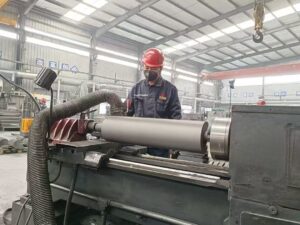
Main Production Process
Ingredient Mixing and Molding
After pre-treating the raw materials, you should proportionally feed them into the mixing machine. And mix them at a temperature of 160-180℃ for more than 4 hours to ensure that the binder evenly coats the aggregate particles, forming a pliable paste.And you need to strictly control the temperature, time and stirring intensity to avoid uneven distribution of the binder. After mixing, you should select the shaping method according to the product shape such as extrusion molding, compression or isostatic pressing molding.
Pressing and Forming
The pressing process involves compacting the paste into a raw product with a certain density and shape. The pressure ranging from 50 to 300 MPa and you can adjust the holding time according to the product specifications. So after molding the green body after molding can ensure precise dimensions, which lays the foundation for the subsequent processes.
Drying
The green body contains a large amount of moisture and volatile substances, so it needs to undergo low-temperature drying treatment. You need to gradually remove the moisture and low-boiling-point volatile substances to avoid cracking and deformation of the dough due to rapid heating.
Emprenye
The products after firing have certain pores, which needs to be filled through the impregnation process. This process can enhance the density, strength and air tightness, which impregnation agents use asphalt, resin, etc. You should immerse them into the pores of the products in a high-temperature and high-pressure environment and carry out a second firing. It can increase the density of the products by 10% – 20%, significantly enhancing their mechanical strength and corrosion resistance.
Grafitleştirme
Graphitization is the process placing the the baked products in a graphitization furnace, which transforms carbon products into graphite products. At an ultra-high temperature, it causes the carbon atoms to rearrange and forms a regular graphite crystal structure. This process endows the products with excellent electrical conductivity, thermal conductivity, high-temperature resistance, and self-lubrication properties.
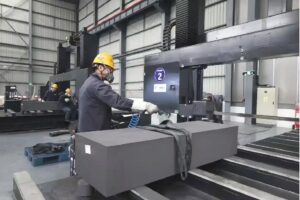
Mechanical Precision Processing
The graphiteized preforms need to undergo precise mechanical processing to process them into finished products that meet the design requirements. For complex irregular parts and thin-walled parts, special processing techniques such as electrical discharge machining and laser processing are adopted.
Process Differences for Different Products
Grafit elektrot
They focuses on their conductivity and high-temperature strength, usually produced through extrusion molding and multiple graphiteification processes.
Structural components such as graphite crucibles and graphite tubes
They are formed by molding or isostatic pressing, and the number of impregnations is increased to enhance density.
Graphite seals
They select fine-grained aggregates and optimize the mixing and processing techniques to achieve high wear resistance and low friction coefficient.
Thermal field graphite
They use high-purity raw materials, isostatic pressing and deep graphiteification, and control the ash content strictly.
Main carbon and graphite products and applications
Graphite Electrode Type
It includes ordinary power, high power, and ultra-high power, used for electric arc furnace steelmaking and iron alloy smelting in electric arc furnaces.
Graphite Tubes, Graphite Rods, Graphite Crucibles
Graphite tubes and graphite rods possess are used in high-temperature furnace tubes, conductive rods, heating elements, etc. The graphite crucibles can melt iron, copper, aluminum, precious metals, and non-ferrous metals, ensuring the purity and quality of the melted metals.
Carbon Graphite Seals
You can use them in pumps, valves, compressors, engines and other equipment to reduce the risk of equipment leakage and wear and tear.
Thermal Field Graphite Components
As core consumables for the semiconductor and photovoltaic industries, they include graphite heaters, crucibles, flow diverters, insulation tubes, etc.
Özel Grafit Ürünler
This include high-purity graphite, flexible graphite, graphite molds, and EDM graphite electrodes, used in semiconductor chip manufacturing, electrical discharge machining and etc.
Sonuç
The manufacturing process of carbon and graphite products involves multiple steps such as raw material selection, mixing and molding, and etc. The technical control at each stage directly affects the quality of the products. The technical control at every stage directly affects the quality of the product, you should control the entire process.
 TR
TR  EN
EN  RU
RU  FR
FR  DE
DE  KO
KO  UK
UK  JA
JA  PT
PT  CEB
CEB  AZ
AZ  BN
BN  VI
VI  ES
ES  ES_ES
ES_ES  ID
ID  IT
IT  ES_AR
ES_AR  HI
HI  AR
AR  KK
KK  EL
EL  ZH
ZH  FA
FA  NL
NL