
Inleiding
In modern industry, the manufacturing of key products such as photovoltaic silicon wafers, semiconductor chips, and new energy batteries all require precise control of high-temperature environments. Graphite thermal field is the core of this system, which has become a key basic component supporting multiple high-tech industries.
Basic Definition of Graphite Thermal Field
Scientific Definition
Graphite thermal field is a dedicated system that builds and maintains an accurate and stable high-temperature environment during the crystal growth process. It uses high-purity graphite as the core material and is constructed through specific structural design and component combination. It is composed of multiple functional components, providing a stable, uniform, and controllable high-temperature environment for specific processes. And it ensures that the processed materials achieve the expected physical or chemical changes under the thermal effect.
Essential Characteristics
Its essential characteristic lies in the core of the high temperature resistance, excellent heat conductivity and chemical stability of graphite. And establish a precise, stable and long-lasting thermal environment that is suitable for both single-crystal and polycrystalline growth requirements. It can adapt to high-temperature working conditions, realizing a complete functional loop of heating – maintaining heat – temperature control. And because of the graphite heat conductivity, it can withstand high temperatures for a long time without failure. And it can control the temperature range error within an extremely small range, meeting the requirements of precision manufacturing. In addition, it possesses extremely strong adaptability to various scenarios, which can be custom-designed in terms of structure, size, and performance according to specific needs.
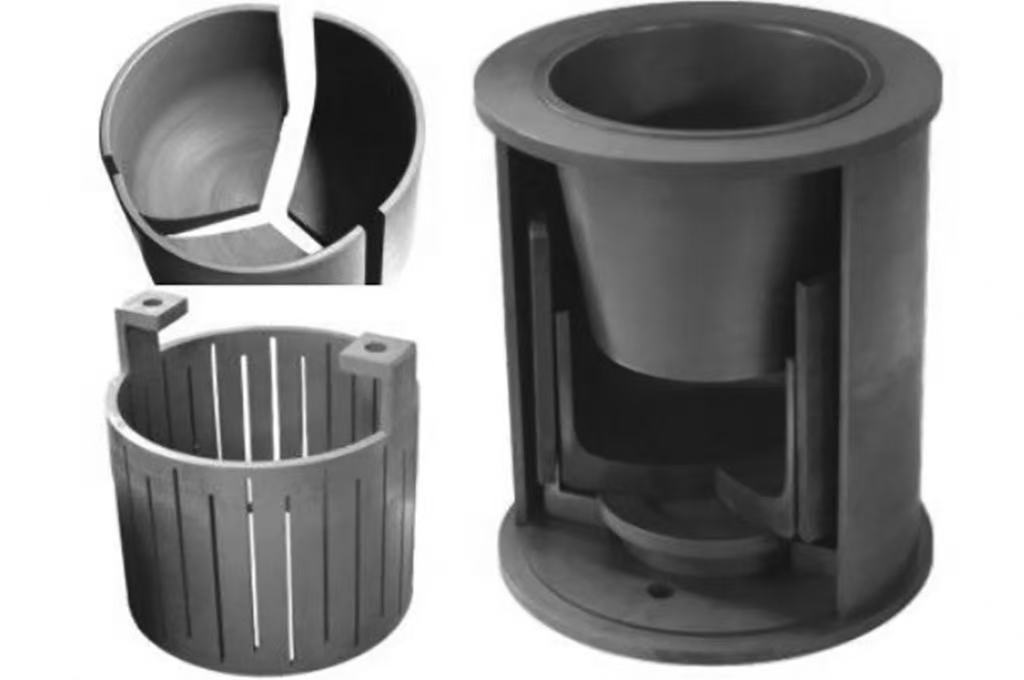
Core Components
Heating Components
It is the heat source, which convert electrical energy and other forms of energy into heat energy. And it can provide a high-temperature foundation for the heat field and its shape can be processed into different forms. It generates heat through the resistance effect when powered on, and then disperses the heat throughout the entire heat field. It heats up evenly, enabling stable operation in high-temperature vacuum or inert gas environments. And it has long service life, which is a key component for supporting difficult high-temperature processes.
Insulation Components
Its main function is to reduce heat loss to the outside, maintain a high internal temperature environment. And it lowers the external temperature, which ensures the safety of the equipment and energy efficiency. Its core components are graphite insulation felt and graphite hard felt. It can prevent temperature fluctuations caused by heat loss, and then ensure stable internal temperatures.
Supporting and Positioning Components
They are used for fixing the heating body, insulation components, and the workpiece to be processed. Also they can ensure that all components remain stable and do not shift under high temperatures. They are the framework of the hot field, which mainly include grafiet verwarmingselementen, graphite supports, graphite crucibles, and graphite rods.
Auxiliary Components
They do not directly participate in the process, but they are crucial for the stable operation and precise control.
Temperature measurement component (such as thermocouples, optical pyrometers, etc.)
It monitor the internal temperature of the heat field in real time and feed the data back to the control system.
Atmosphere control component (such as air intake ports, air outlets and gas purification devices)
It can introduce inert gases such as argon or maintain a vacuum to prevent the material from oxidizing at high temperatures.
Cooling component (such as water cooling or air cooling)
It cools the external metal connectors of the heat field and other parts to prevent high-temperature conduction from damaging other parts of the equipment.
Key Performances
Weerstand tegen hoge temperaturen
The melting point of graphite is 3850℃, easily adapt to the high-temperature processes ranging from 1000 to 2200℃. More importantly, during long-term high-temperature operation, the mechanical properties such as strength and hardness gradually decline slowly. So it will not fracture or deform due to high temperatures, ensuring the long-term stable operation of the thermal field.
Uniform Heat Conduction
Because of the excellent graphite thermal conductivity and good isotropy, its thermal conductivity varies little in different directions. Its heating body can quickly and uniformly transfer heat, and control the temperature difference within ±5℃. This avoids problems such as uneven crystallization and performance differences in materials due to local temperature differences. And it provides a key guarantee for precise manufacturing of photovoltaic silicon wafers, semiconductor chips, etc.
Thermische stabiliteit
Graphite has an extremely low thermal expansion coefficient, which makes it less prone to cracking or peeling. With the high stability, the thermal field can be rapidly raised from room temperature and then cooled down. It ensures that the process can be repeated without failure and maintains production continuity.
Hoge zuiverheid
Graphite thermal field materials need to undergo high-purity purification, with the total content impurities controlled below 10 ppm. This prevents the release of impurities to the processing materials under high temperatures, which ensures product quality from the source.
Toepassingen
Photovoltaic Industry
Preparation of monokristallijn silicium
This process must be carried out at a high temperature of 1420℃, which has extremely high requirements. The graphite thermal field has temperature gradient stability and no impurity contamination, which perfectly meets the demands. It can precisely hold the molten silicon material, and provide a continuous and stable heat source. It ensures that the silicon material slowly cools and crystallizes from the molten state, ultimately forming high-purity and defect-free monocrystalline silicon rods. This provides high-quality substrates for subsequent photovoltaic silicon wafer processing and directly determine the photoelectric conversion efficiency of photovoltaic modules.
Halfgeleiderindustrie
Substrates and Chip Manufacturing
It can operate stably at ultra-high vacuum environments below 10-5 Pa and at temperatures ranging from 1200 to 1300℃. This ensures the crystalline quality and surface flatness of the substrate materials, providing high-quality substrates for chip manufacturing. You can also use it in the doping and sintering processes of chips, because it can precisely control the temperature. It ensures that impurity atoms are uniformly diffused into the interior of the chips, significantly improving its electrical performance.
New Energy Industry
Llithium-ionbatterijen
Because of the high thermal conductivity and uniformity, it can ensure the consistent sintering of material particles. And it avoids performance fluctuations caused by local temperature differences, which is used to product cathode materials for lithium-ion batteries. It also prevents impurity contamination, which ensures the energy density and cycle life of the battery.
Hydrogen fuel cells
It precisely controls the temperature under inert gas protection to achieve efficient high-temperature composite of catalysts and proton exchange membranes. It enhances the sealing performance and catalytic activity of the membrane electrode, which improves the power generation efficiency.
Andere velden
In de ruimtevaart
You can use it to manufacture superalloy components such as turbine blades and combustion chambers of spacecraft engines. Graphite thermal field provides stable sintering conditions, meeting the requirements of being prepared under a vacuum environment with a temperature above 1500℃.
The growth of artificial crystals
You can use it to process sapphire and laser crystals, which requires strict temperature gradients and a long-term stable high-temperature environment. Because of the excellent thermal stability and temperature control accuracy, it has become the core equipment for their industrial production.
Conclusie
The graphite thermal field is centered on graphite materials and is constructed through the collaboration of multiple components. It provides a stable and precise high-temperature environment for industrial production, perfectly meeting the stringent requirements of industries. It is used in photovoltaics, semiconductors, and new energy, which runs through the core links of multiple strategic emerging industries.
 NL
NL  EN
EN  RU
RU  TR
TR  FR
FR  DE
DE  KO
KO  UK
UK  JA
JA  PT
PT  CEB
CEB  AZ
AZ  BN
BN  VI
VI  ES
ES  ES_ES
ES_ES  ID
ID  IT
IT  ES_AR
ES_AR  HI
HI  AR
AR  KK
KK  EL
EL  ZH
ZH  FA
FA