
In the manufacturing of high-end materials, the traditional single-axis compression with one-way pressure application results in uneven density of the preform and high stress. This makes it difficult to process complex parts, which is not suitable for high-end powders such as graphite and hard alloys. Cold isostatic pressing can apply pressure uniformly in all directions, which compensates for the shortcomings of traditional processes. With dense and stable preform, you can widely use it in industries such as new energy, aerospace, and semiconductors.
Core Definition of Cold Isostatic Pressing Technology
Cold Isostatic Pressing (CIP) is a precise forming process specifically for powder materials under normal temperature conditions. It does not require heating, which core principle is to use a liquid as the pressure transmission medium. It can apply uniform pressure in all directions to the powder raw material, which compacts the loose powder into a solid body with high density and high uniformity. Its process will not cause high-temperature thermal damage, and its molds used for forming are mostly made of flexible and elastic materials. It can meet the forming requirements of various irregular, large-sized, and complex-structured powder blanks. And it completely density stratification of the green body, concentrated residual stress, and forming dead corners caused by one-directional pressing. And significantly improving the qualified rate of finished products and material mechanical properties in subsequent sintering processing.
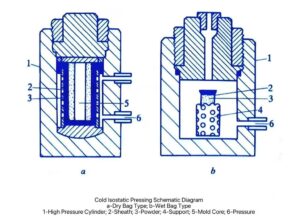
Working Principle of Cold Isostatic Pressing
The core physical basis of cold isostatic pressing molding is the Pascal principle of liquid static pressure transmission. It means that the static pressure within a sealed container can be evenly and comprehensively transferred to all contact surfaces. And the entire molding process is standardized and refined, and can be divided into three core steps:
Pre-treatment and filling process of the raw materials
Carry out screening, drying and degassing treatment on the raw materials, which eliminate powder agglomeration and water vapor impurities. It ensures the powder is loose and uniform, avoiding defects such as air holes and cracks after molding.
Then, you should fill the pre-treated powder into the internal cavity of the custom flexible rubber mold. After that, remove the air inside the mold, which could cause voids and uneven density in the green body.
High-pressure compression molding process
You need to place it inside a high-pressure sealed pressure vessel and inject high-pressure liquid media such as water. It causes the loose powder particles to closely adhere to each other, which completes the formation of a solid preform.
Carry out pressure relief and demolding process
When ensuring that the powder is fully compacted and shaped, you should slowly release the internal pressure of the pressure vessel. It allows the pressure to smoothly drop back to normal pressure, which avoids cracking of the green body due to rapid pressure relief. Then you can obtain a formed body, which can directly proceed to subsequent processes such as sintering and fine processing.
Main Categories of Cold Isostatic Pressing Technology
Wet Cold Isostatic Pressing
Its core operational feature is that the mold is externally filled and the entire process is immersed in pressure. The operational process is highly flexible, which completes powder filling, mold sealing outside the high-pressure pressure vessel. You can completely immerse it in the high-pressure liquid medium of the pressure vessel, achieving full contact with the pressure medium. And you can customize it to produce large-sized, irregularly shaped, non-standard structures, irregular curved surfaces, and thin-walled complex structure blanks according to requirements. It has high degree of freedom in mold customization, which size range of the formed products is wide. And it can be adapted to high-hardness and difficult-to-mold special powder materials. However, its entire process is intermittent batch operation, which single batch molding cycle is long, resulting in limited production efficiency. So you can mainly use it to the production and processing of small-batch, multi-category, large-sized, and complex-shaped parts.
Dry Cold Isostatic Pressing
Its core innovation lies is that the molds are internally fixed and do not require overall immersion. The flexible molds are directly fixed and integrated inside the high-pressure pressure vessel, which need not to be disassembled. You can complete the sealing pressurization, holding pressure molding, and depressurization and demolding process. Because it does not need to be repeatedly disassembled and immersed in the medium, it has short production cycle. And with extremely high operational efficiency, it eliminates the cumbersome procedures, which enables continuous assembly line operations. And it can result in higher product cleanliness, which ensures consistency and stability of the finished products are excellent. But its mold specifications are fixed and cannot be easily replaced, which is only suitable for the production of regular-shaped and standardized-sized raw materials.
Core Industrial Application Domains
Forming of Special Powder Materials such as グラファイト, Ceramic, Silicon Carbide
Using it can solve the cracking and uneven density issues, which achieve the uniform and dense molding of these special powders. And the finished products after sintering have high density, high temperature resistance, corrosion resistance, and excellent mechanical properties. You can widely use it in scenarios such as photovoltaics, 半導体, high-temperature metallurgy, and industrial kilns.
Preparation of Metal Powders, Carbide Dies
You can use it in the field of powder metallurgy, the preparation of green bodies for iron powder, titanium powder, tungsten powder and hard alloy composite powders. These has extremely high requirements for the uniformity of the molding and the stability of the structure. It can uniformly compress the metal powders in all directions, which results in a very low porosity of the molded body and a uniform microstructure. This avoids local looseness and insufficient strength that occur in traditional pressing methods, which enhances the wear resistance. And after sintering and fine processing, you can use it to manufacture high-strength wear-resistant alloy tools, mining wear-resistant accessories, etc.
Battery Electrode Materials, New Energy Ceramic Components
Due to its uniform density and regular pore structure, it does not damage the sensitive materials of new energy. And it can effectively improve the energy density and cycle stability of the battery, which stabilizes the product performance. So it is suitable for the large-scale production needs of new energy batteries, energy storage equipment, and core components of new energy vehicles.
Manufacturing of High-End Components for Aerospace and Precision Machinery
It can produce high-density, low-defect and highly consistent high-end blanks, which effectively eliminates internal stresses in the blanks. And then avoiding deformation and cracking during subsequent processing and high-temperature use. So you can use it in the preparation of ceramic cores for aircraft engines, precision alloy parts for aircraft, high-end mechanical seals, and precision transmission components.
結論
Based on the Pascal principle, CIP can uniformly press powders at room temperature, which makes up for the shortcomings of single-axis pressing. It is divided into wet and dry, which are respectively suitable for custom production of irregular parts and standardized mass production.
With the development of high-end manufacturing and new energy industries, it will continue to be updated.
 JA
JA  EN
EN  RU
RU  TR
TR  FR
FR  DE
DE  KO
KO  UK
UK  PT
PT  CEB
CEB  AZ
AZ  BN
BN  VI
VI  ES
ES  ES_ES
ES_ES  ID
ID  IT
IT  ES_AR
ES_AR  HI
HI  AR
AR  KK
KK  EL
EL  ZH
ZH  FA
FA  NL
NL