
The application scenarios of graphite products are constantly expanding, so it has raised higher requirements for their forming accuracy, structural complexity, etc. And graphite molding is the oldest, most widely used and most technologically mature forming process in graphite product manufacturing. And it is the core link that determines the quality and performance of graphite products.
Basic Definition of Graphite Molding
Explanation of the Concept of Graphite Molding
Graphite molding is a typical application of powder metallurgy molding technology in the processing of graphite materials. It first fill the customized metal mold cavity with the graphite powder raw materials that have been proportioned and mixed. Then, through hydraulic or pressurized means, it results in the formation of a graphite preform with a certain strength. After undergoing post-treatment processes such as high-temperature sintering, graphitization, and impregnation, it manufactures the qualified graphite products. It belongs to the cold pressing molding technology. The entire molding process is completed at room temperature. Because of only carrying out high-temperature heating during the post-processing stage, it can avoid thermal deformation of raw materials. So it ensures the dimensional accuracy of the product and you can control the core performance of the product precisely.
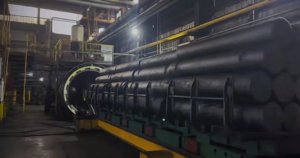
Simple Differences from Extrusion and Isostatic Pressing Processes
Extrusion process is a continuous manner, it extrude the paste-like graphite material from the mold opening by a screw extruder. It has high production efficiency and unlimited length, which is suitable for regular shapes such as rods, bars, and tubes. Isostatic pressing molding transmits uniform three-dimensional pressure through a liquid or gas medium, so its products are isotropic. And with extremely high density, and have uniform properties, it is suitable for ultra-high-end precision graphite products in fields. Graphite molding is an intermittent production method, has a simpler equipment, which is easy to operate, and has high production efficiency. And relying on customized molds to process any complex three-dimensional structures, it can process any complex three-dimensional structures. Although the isotropy is slightly lower than that of isostatic pressing products, it fully meets the performance requirements of medium and high-end industrial products. And due to its uniform product density, it is more suitable for the production of irregular and high-precision parts.
Applicable Products
Its application scope includes multiple fields in industrial production such as semiconductor industry, metallurgical industry, new energy industry and etc. As the most widely used molding method in the industrial field, you can use it to process graphite gaskets, 흑연 전극 and etc.
Main Raw Materials of Graphite Molding
Matrix graphite powder is the core raw material, which is divided into two categories: natural flake graphite and artificial graphite. And it usually use the high-purity graphite powder and fine-grained graphite powder to ensure product quality. And you can use binder to bond graphite particles, ensuring that the green body does not break during demolding and transportation. Finally, you can add some functional additives within 0.5%–2% according to the product usage requirements. They can improve high-temperature stability, enhance wear resistance, improve conductive and heat-conductive properties, and etc.
Process Flow of Graphite Molding
Ingredient Mixing and Blending
You should put graphite powder, binder and functional additives into the mixer according to the preset ratio and stir them. Based on the type of binder, you can select different types of stirring, and the stirring time is usually 30-60 minutes. It ensures uniform dispersion of all components, and guarantees the consistency of the density of the subsequent formed body.
Pre-pressing/Granulation
After mixing the 흑연 분말, you should use pre-pressing crushing or a rotating granulator to turn the powder into uniform particles. This will improve the fluidity of the raw materials and the uniformity of loading, enhancing the density of green piece.
Loading into Mold
By using an automatic weighing fabric system, you can precisely and evenly fill the granulated raw materials into the mold cavity. Because the uniformity of loading affects the quality of the finished products, you should strictly control the loading quantity and filling density. This ensures the accurate size and uniform density of the formed products, avoiding demolding and cracking of the green pieces.
Pressure Forming (Cold Pressing)
Then you need to place the filled mold on the working table of the hydraulic press, expelling the internal air. Applied a unidirectional or bidirectional pressure, the powder particles are tightly compressed, forming a green body with certain mechanical strength. This can effectively reduce the density gradient of the green body and improve the product uniformity.
Demolding
After that, you should eject the green piece smoothly from the mold through the hydraulic demolding mechanism. During this process, you should avoid cracks, deformations, missing corners, etc. in the green piece due to uneven force. After demolding the green piece, you need to transport it to the sintering process to prevent moisture absorption and softening.
Sintering, Impregnation, Graphitization
Sintering
You should place the green body in a firing furnace to undergo thermal decomposition and 탄화, forming a carbonaceous framework. Under the protection of inert atmospheres and high temperature for several hours, it can enhance the strength and density of the body.
함침
For products with high density and high sealing requirements, you can add asphalt, resin, or metals for vacuum impregnation. They fill the internal pores of the body and improve its mechanical properties, sealing performance, and wear resistance.
그래피타이제이션
You need to place the sintered body in a graphitization furnace and heat it, which converts amorphous carbon into ordered graphite crystal structure. It significantly enhances the product’s electrical conductivity, thermal conductivity, high-temperature resistance, and chemical stability.
Precision Processing (Grinding, Turning, Polishing)
Even though through sintering and graphitization, the size of the green body still has certain deviations, which need to be precisely processed. By using CNC machining centers, surface grinders and polishing machines, it can meet the precision requirements of high-end industrial products.
Characteristics and Advantages of Graphite Molding Process
Capable of manufacturing complex shapes and high-precision products
You can use it to process various structural products such as irregular shapes, porous materials, and complex curved surfaces. And after subsequent precision processing, it can meet the strict requirements of high-precision graphite components in fields.
Uniform density, high strength
It can ensure the product with no obvious void areas or density gradients and has excellent bending strength and wear resistance. So it can withstand complex working conditions such as high temperature, high pressure, and high-speed friction, having a long service life.
Stable dimensions, less prone to deformation
With the graphite’s extremely low thermal expansion coefficient, the molding process and the high-temperature graphitization treatment effectively eliminate internal stresses. So the product maintains excellent dimensional stability which is not prone to deformation, ensuring the stability of equipment operation.
Suitable for mass production of seals and structural components
It has high maturity and can easily achieve automation, particularly suitable for the manufacturing of large quantities of industrial products. You can use it to process graphite sealing rings, bearings, and structural components, which can effectively reduce unit production costs.
Controllable cost, mature process
The molding press equipment has lower investment, shorter production cycle, higher raw material utilization rate, stronger controllability of process parameters. Due to controllable overall production cost, it is the preferred process for large-scale production of medium and high-end graphite products.
결론
Graphite molding is the core process for the industrial application of graphite materials and has become the mainstream production technology. With flexible molding, controllable precision, stable performance and scalability, it meets the processing requirements of various complex-structured and high-precision graphite products. And it is suitable for large-scale industrial production, which provides solid material support for the development of fields.
 KO
KO  EN
EN  RU
RU  TR
TR  FR
FR  DE
DE  UK
UK  JA
JA  PT
PT  CEB
CEB  AZ
AZ  BN
BN  VI
VI  ES
ES  ES_ES
ES_ES  ID
ID  IT
IT  ES_AR
ES_AR  HI
HI  AR
AR  KK
KK  EL
EL  ZH
ZH  FA
FA  NL
NL